
Downspout Extensions: How Far Should Water Discharge from the House (Texas Best Practices)

Key Takeaways
- In Texas, downspouts should discharge at least 5–10 feet from the foundation.
- Poor drainage is one of the leading causes of foundation problems.
- Flexible or buried extensions can help reduce slab movement.
- Expansive clay soil makes proper water control critical.
- Redirecting runoff is a low-cost way to prevent expensive foundation repair.
Rainwater management plays a larger role in foundation health than many homeowners realize. In Texas, expansive clay soils react strongly to moisture changes, making proper drainage an essential part of protecting a home’s structure.
Many foundation problems begin with poor drainage rather than structural defects. When downspouts discharge beside the slab, excess moisture can accumulate near the base of the home and affect the supporting soil. Installing proper downspout extensions and maintaining effective foundation drainage in Texas helps reduce that risk.
How far should downspouts drain from the house? In most cases, downspouts should discharge 5 to 10 feet away from the foundation. This distance prevents roof runoff from saturating soil directly beside the slab. Homes built on expansive clay soils—common throughout Texas—benefit from longer extensions or buried drain lines that move water safely away from the structure.
Even small drainage improvements can prevent costly structural repairs. For homeowners experiencing structural concerns, learn more about foundation repair services and available stabilization options.
Why Downspout Extensions Matter for Texas Foundations
Water is one of the primary environmental forces affecting residential foundations. When rainwater repeatedly saturates soil near a home, it alters the moisture balance around the slab.
Texas soils frequently contain expansive clay minerals. According to the U.S. Geological Survey, these soils can swell when saturated and shrink during dry periods, producing ground movement that affects buildings and infrastructure (USGS, n.d.).
Downspout extensions help limit these moisture swings by carrying roof runoff farther from the structure and reducing soil pressure around the foundation.
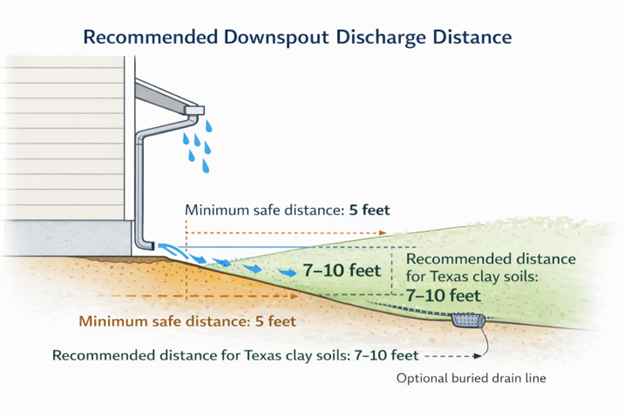
How Far Should Water Discharge from the House?
Proper drainage distance depends on soil conditions, rainfall intensity, and yard grading. However, general guidelines provide a reliable starting point for most Texas homes.
Minimum Distance (5 Feet Rule)
Many drainage specialists consider five feet the minimum safe distance for directing water away from a foundation. At this distance, runoff begins dispersing across the yard rather than concentrating beside the slab.
This minimum distance may be adequate where soil drains well, and the yard slopes away from the structure.
Ideal Distance for Texas Clay Soil (7–10 Feet)
Because expansive clay soils are common across Texas, many experts recommend extending downspouts 7–10 feet away from the house whenever possible.
Moving runoff farther into the yard reduces moisture changes in soil immediately adjacent to the foundation.
When You May Need More Than 10 Feet
Some properties require longer drainage distances.
Homes on flat lots or properties with poor grading may benefit from buried drain lines that carry runoff well beyond the foundation perimeter. In some cases, drainage systems connect downspouts to underground piping that directs water toward street drains or designated runoff areas.
The International Code Council notes that proper site drainage is essential to prevent water accumulation near foundations and structural elements (ICC, n.d.).
Signs Your Downspouts Aren’t Draining Far Enough
Several visible clues can indicate that roof runoff is not being carried far enough from the home.
Erosion channels beneath the downspout outlet suggest repeated water flow in the same location. Over time, this runoff can remove soil and expose portions of the foundation.
Standing water after storms is another warning sign. Puddles near the base of the home may indicate that the discharge point is too close to the structure.
Types of Downspout Extensions (Pros & Cons)
Several extension options can redirect roof runoff away from the house.
Flexible Plastic Extensions
Flexible plastic extensions are one of the most common homeowner solutions. These lightweight tubes attach directly to the downspout and carry water several feet away from the house.
They are inexpensive and easy to install, making them a practical option for simple drainage improvements. However, they remain visible in the yard and can be damaged by lawn equipment if poorly positioned.
Buried Drain Lines
Buried drain lines provide a more permanent drainage solution. These systems route runoff through underground piping that carries water safely away from the structure.
Although installation requires trenching and careful grading, buried drains provide long-term water management while preserving the appearance of the landscape.
Splash Blocks
Splash blocks are simple concrete or plastic trays placed beneath downspouts to disperse runoff across the ground surface.
While they reduce erosion directly under the downspout, splash blocks alone often do not move water far enough from the foundation to prevent soil moisture changes.
DIY vs Professional Drainage Correction
Some drainage improvements can be handled as simple DIY projects. Installing flexible extensions or repositioning splash blocks may improve water flow immediately.
However, more complex drainage problems may require professional evaluation. Homes experiencing persistent standing water, soil erosion, or structural movement often need grading adjustments or engineered drainage systems.
Contractors specializing in drainage solutions can evaluate how water moves across the property and recommend appropriate corrections.
Preventing Foundation Damage with Proper Water Management
Preventive drainage maintenance is typically far less expensive than structural repair. Cleaning gutters regularly, ensuring downspouts discharge several feet from the house, and maintaining proper yard grading all help protect the foundation.
Proper grading allows rainwater to flow naturally away from the structure rather than pooling near the slab.
If persistent drainage problems or structural symptoms appear, a professional inspection may help identify the underlying cause before damage becomes more severe.
In some cases, engineered drainage solutions may be required to correct persistent water management problems around the home.
School Building Case Study: Foundation Damage Caused by Poor Drainage
Improper drainage has contributed to many foundation problems across Texas. In Booker, Texas, engineers investigated structural settlement in a school building after moisture fluctuations created voids beneath the foundation.
The investigation found that expansive clay soil beneath the structure expanded during wet conditions and contracted during dry periods. Water accumulation near the building contributed to uneven soil movement that eventually caused cracking and structural distortion requiring stabilization work (Childers Brothers, n.d.).
This illustrates how poorly managed runoff can influence foundation performance over time.
Homeowner Drainage Inspection Checklist
Homeowners concerned about drainage can perform a quick inspection around their property.
- Check that downspouts discharge 5–10 feet away from the house
- Confirm soil slopes away from the foundation
- Look for erosion channels or standing water
- Inspect gutters for clogs or overflow
If multiple issues appear together, a professional inspection may help determine whether drainage corrections are needed.
Protecting Your Foundation Investment
Preventive drainage improvements often cost far less than structural repairs. Directing water away from the home and maintaining gutters can significantly reduce the risk of foundation movement.
For homeowners experiencing structural concerns, learning more about foundation repair services can provide insight into available stabilization options.
Visible cracks or structural symptoms may indicate deeper drainage issues. Understanding the causes of foundation cracks allows homeowners to recognize early warning signs.
In some cases, engineered drainage solutions may be required to correct persistent water management problems around the home.
FAQs
Is 3 feet far enough for a downspout?
Three feet is generally considered too short for safe drainage in most homes. Water discharged this close to the foundation can soak directly into nearby soil and contribute to expansion or erosion. Many drainage specialists recommend directing runoff at least 5 feet away, with 7 to 10 feet providing better protection in areas with expansive clay soils.
Can improper drainage cause foundation cracks?
Yes. When water repeatedly collects near a foundation, it can change the moisture content of the surrounding soil. Expansive clay soils may swell when wet and shrink when dry, producing movement beneath the structure. Over time, this shifting can lead to structural stress, which can contribute to foundation cracks.
Should downspouts be buried underground?
Buried drain lines can be an effective drainage solution, particularly for homes with limited yard space or poor grading. These systems transport runoff through underground piping to a safe discharge location away from the foundation. Proper installation and grading are important to ensure water flows correctly through the drainage system.
How do I know if drainage is affecting my foundation?
Signs of drainage-related foundation issues may include standing water near the house, soil erosion below downspouts, or visible foundation cracks. Interior symptoms such as sticking doors or uneven floors may also indicate soil movement beneath the structure. A professional inspection can determine whether drainage conditions are affecting the foundation.
References
U.S. Geological Survey. (n.d.). Expansive soils and foundation movement.
https://www.usgs.gov
International Code Council. (n.d.). International Residential Code drainage requirements.
https://www.iccsafe.org
Childers Brothers. (n.d.). Booker School foundation repair case study.
https://childersleveling.com/blog/booker-school-foundation-repair-case-study
Get a Free Foundation Inspection (9 value!)
No-obligation evaluation from Texas foundation specialists.
- Free inspection (no obligation)
- Transferable lifetime warranty available
- 30+ years of Texas foundation experience